 Core topics
Articles
This page presents a compact collection of expert articles explaining how industrial control cabinets are designed, manufactured and integrated into automation systems.
How Industrial Control Cabinets Are Built
Manufacturing workflow from requirements and layout planning to assembly, wiring and testing.
ManufacturingAutomationControl cabinetsDesign Process of Electrical Control Cabinets
How engineering decisions shape reliable and service-friendly cabinets.
Electrical designPanel layoutPLCFrom Customer Requirements to Finished Control Cabinet
A realistic project flow from inquiry to delivery and future optimization.
Project workflowB2BSerial Production of Industrial Control Cabinets
Why standardization and repeatability matter for OEM and machine builder projects.
Serial productionOEMTesting and Quality Control in Control Cabinet Manufacturing
How inspections and testing support reliability and consistency.
TestingQualityCommon Mistakes in Control Cabinet Design
Typical design problems that lead to avoidable production and service issues.
EngineeringMaintainability
How Industrial Control Cabinets Are Built
Industrial control cabinets are the nerve center of automated machines and production systems. Companies looking for a manufacturing partner often review capabilities such as engineering quality, assembly processes and testing procedures. Many automation companies therefore cooperate with specialists offering custom industrial control panel building integrated into modern machine production environments. A practical overview of professional manufacturing services can be found here: industrial control panel manufacturing. They house power distribution components, protection devices, PLC hardware, terminals, relays, drives, communication equipment and all of the wiring required to operate a machine safely and reliably.
1. Requirement review and technical clarification
The process starts with technical documentation, customer expectations, standards, environmental conditions, cable interfaces and preferred component brands. The manufacturer checks what is clear, what is missing and where risks may appear later during production or commissioning.
2. Enclosure and component selection
The enclosure is selected based on installation environment, space requirements and protection needs. Components such as circuit breakers, power supplies, PLCs, terminals, contactors, relays and communication modules are then chosen according to the project concept.
3. Layout planning
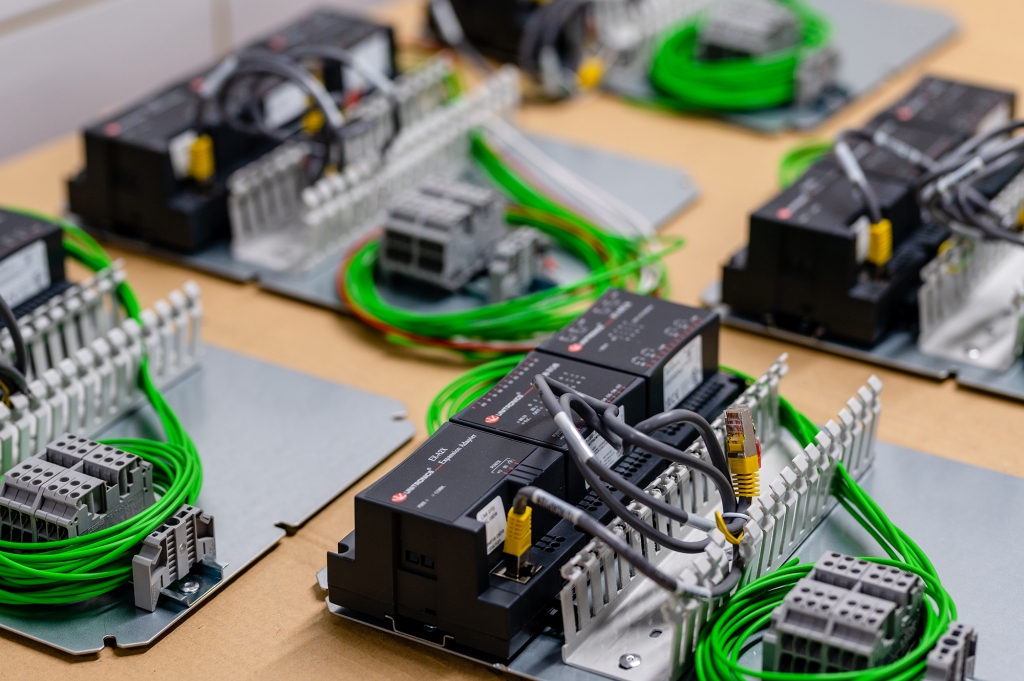
Good layout is essential for serviceability, thermal behavior and workshop efficiency. Engineers plan DIN rails, terminals, cable ducts, reserve space, door-mounted devices and logical separation of power and control components.
4. Mechanical preparation
The mounting plate and enclosure are prepared through drilling, milling and cut-outs for entries, operator devices and cooling accessories where required.
5. Assembly and wiring
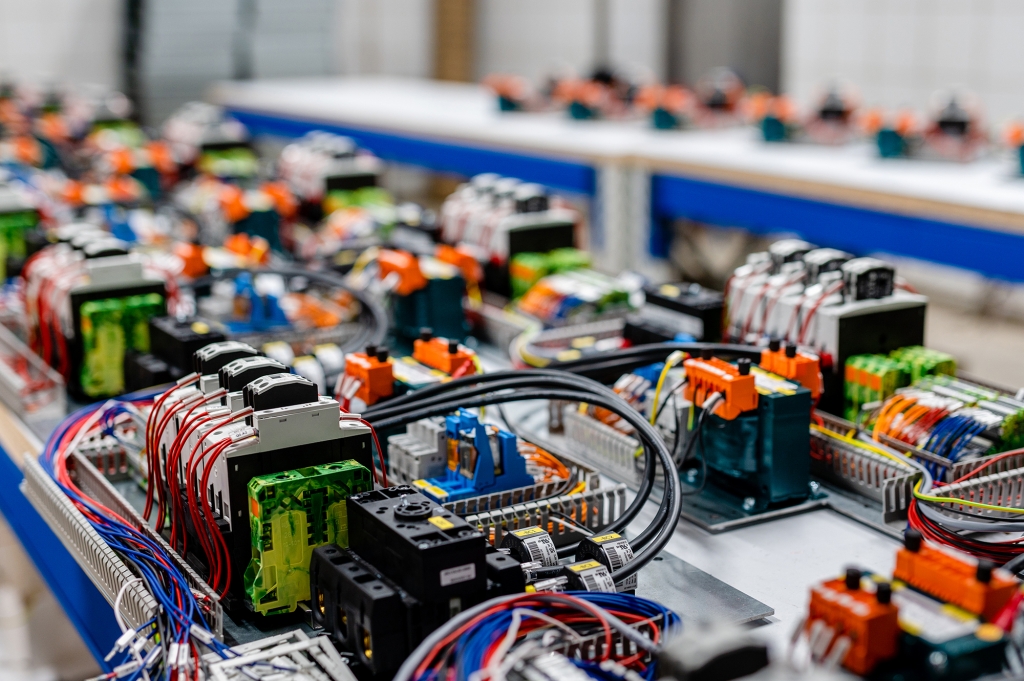
Components are mounted, wires are cut and crimped, and all conductors are routed according to the electrical design. Clear wire labeling and tidy routing matter because they make testing and later service much easier.
6. Testing and documentation
At the end of the build, the cabinet is inspected and tested. Documentation, labeling consistency and delivery preparation complete the workflow.
Design Process of Electrical Control Cabinets
The design phase determines whether a control cabinet will be easy to manufacture, safe to commission and practical to maintain. Many machine builders therefore cooperate with specialized manufacturers who provide complete engineering and assembly services, such as those described here: control cabinet manufacturing services. Strong engineering reduces rework, clarifies procurement and helps production teams build consistently.
1. Collecting technical input
The engineering team gathers the functional description, machine interfaces, safety concept, component preferences, target markets and required standards. Missing details should be clarified early to avoid expensive changes later.
2. Defining the electrical architecture
This includes incoming power concept, voltage levels, PLC topology, remote I/O, drive strategy, safety logic and communication interfaces. These decisions shape cabinet size, wiring density and commissioning effort.
3. Schematic creation
Electrical schematics define devices, connections, terminals and circuit logic. Good schematics help not only engineers but also workshop teams, testers and service personnel.
4. Layout and space planning
Component placement must consider cooling, wiring routes, service access, door equipment and reserve space for future changes or variants.
5. Compliance and manufacturability review
Designers verify conductor sizing, labeling rules, circuit separation, environmental constraints and practical workshop feasibility. Engineering works best when it is closely connected to real production experience.
From Customer Requirements to Finished Control Cabinet
Industrial control cabinet projects are both technical and organizational. Professional suppliers support customers from engineering to final assembly. A detailed description of such services can be found on the manufacturing page: industrial control panel manufacturing. The final quality depends on how well the supplier translates customer expectations into drawings, procurement, assembly and testing.
1. Initial inquiry
The project begins with a request for quotation, functional information, project timing and at least part of the technical package.
2. Technical clarification meeting
Both sides align on dimensions, standards, cable interfaces, testing expectations, documentation format and the installation environment.
3. Offer and production concept
The supplier prepares a quotation and defines whether the project will be handled as a one-off cabinet, prototype, pre-series build or repeat production.
4. Engineering and procurement
Schematics, layouts and released BOM data guide purchasing and workshop preparation. Strong coordination here prevents delays.
5. Assembly, testing and delivery
The cabinet is assembled, wired, inspected and tested. Good suppliers also use commissioning feedback to improve future projects.
Serial Production of Industrial Control Cabinets
Serial production is different from building a single custom cabinet. It requires stable documentation, purchasing discipline, standard assembly logic and repeatable testing.
From prototype to repeatable product
Many serial projects begin with a prototype or pilot build. That first version validates layout, assembly effort, testing logic and material availability.
Stable documentation
Released schematics, labels, layouts and BOM versions are essential. Frequent uncontrolled changes reduce efficiency and increase error risk.
Standardized assembly
Repeat manufacturing benefits from harmonized mounting patterns, cable routing rules, terminal concepts and labeling standards.
Procurement and lead time planning
Volume production exposes the real impact of component availability, lead times and single-source risk. Good suppliers combine engineering structure with purchasing awareness.
Quality checkpoints
Reliable serial production uses checkpoints at multiple stages, not only a final inspection at the end.
Testing and Quality Control in Control Cabinet Manufacturing
Testing and quality control are central to professional cabinet building. In professional manufacturing environments the entire workflow—from planning to final testing—is structured to guarantee reliability. An example of such production capability is described here: professional control cabinet manufacturing. A single wiring mistake, labeling inconsistency or undocumented substitution can delay commissioning and create avoidable service costs.
Incoming material checks
Teams verify component identity, rating and visible condition before assembly begins.
Assembly checks
Mechanical inspections review fastening quality, spacing, DIN rail alignment and cabinet cleanliness.
Wiring inspection
Inspectors look at routing, ferrules, terminal assignment, numbering and protective conductor connections.
Electrical tests
Depending on the project, tests may include continuity checks, insulation resistance measurement, device verification and selected function tests.
Traceability
Good manufacturers maintain revision status, inspection records and documented deviations so builds remain transparent over time.
Common Mistakes in Control Cabinet Design
Many cabinet problems are not caused by advanced electrical issues. Experienced manufacturers avoid these mistakes through structured engineering and standardized production processes. More about this approach can be found here: electrical control cabinet assembly. They come from basic design mistakes such as poor spacing, unclear labels or layouts that ignore practical workshop realities.
1. Not enough space in the enclosure
Overly dense layouts restrict airflow, complicate wiring and make maintenance harder.
2. Poor separation of power and control circuits
Unstructured routing can create clutter, confusion and possible EMC issues.
3. Weak terminal planning
Terminal interfaces define the connection between field and cabinet. Poor grouping slows commissioning.
4. Inconsistent labeling
If drawings, device labels and wire markers do not match, testing and troubleshooting become much slower.
5. Ignoring production realities
Designs that look fine on a screen can still be awkward to build. Practical manufacturing input should influence engineering decisions.
About this expert website
Project inquiry
Add your real company details, legal notice, address, phone number and lead form here before publishing.
Main target pages:
Schaltschrankbau / manufacturing
Serial production